







The best Split.io alternatives & competitors, compared


Contents
Split.io was a feature management and experimentation platform built for product teams. In June 2024, it was acquired by the DevOps and software delivery platform Harness and rebranded as Harness Feature Management & Experimentation (FME).
If you're a former Split customer evaluating your options, or if you're just shopping for a feature flag and experimentation platform – here are the best alternatives.
1. PostHog
- Founded: 2020
- Similar to: VWO, LaunchDarkly
- Typical users: Engineers and product teams
- Typical customers: Engineering-led companies and startups
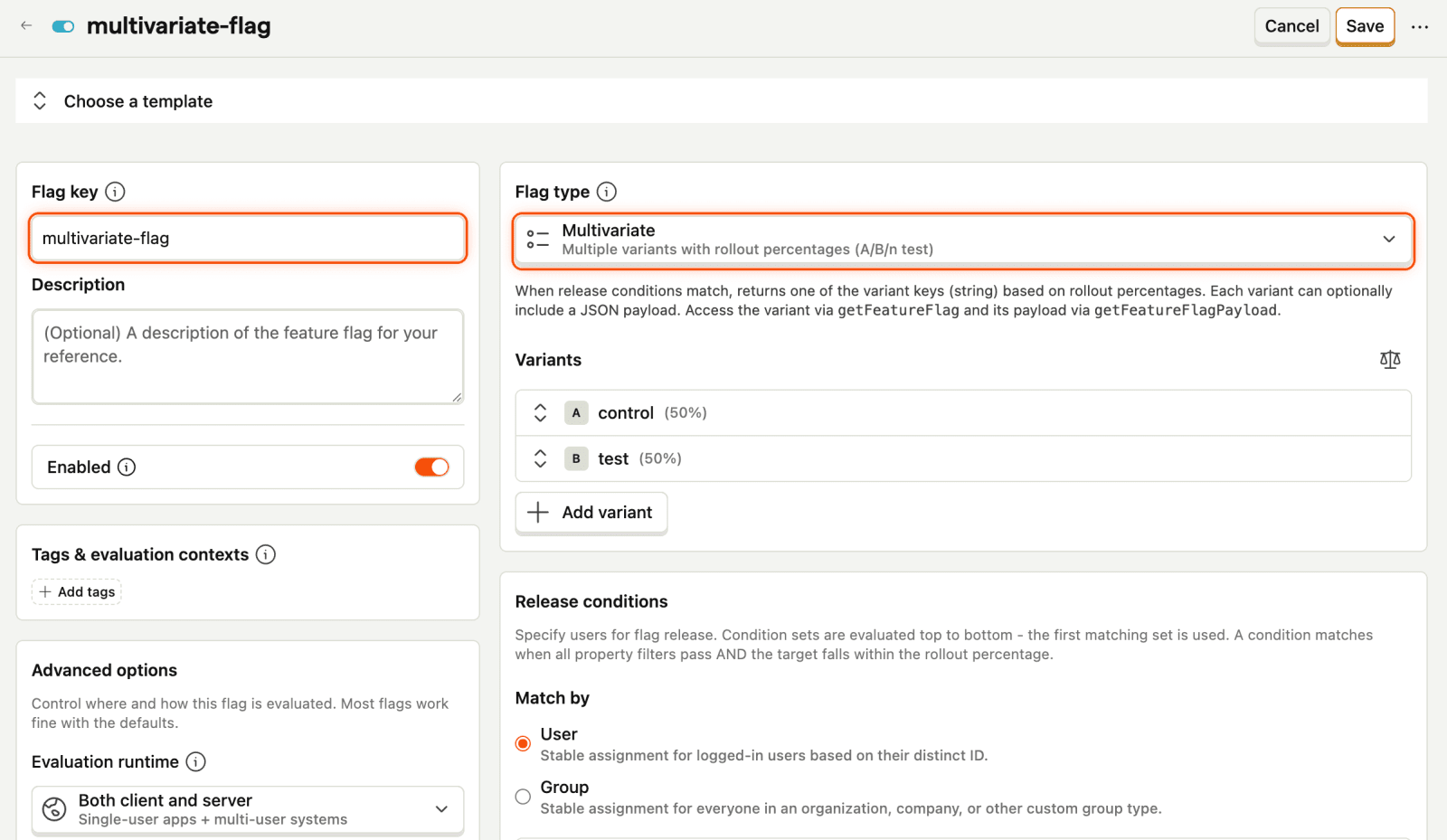
What is PostHog?
PostHog (that's us 👋) is an all-in-one suite of dev tools combining A/B testing, feature flags, product analytics, session replay, error tracking, LLM observability, surveys, and more.
This means it's not only an alternative to Split but also tools like Mixpanel, Sentry, LaunchDarkly, and Hotjar.
Key features
A/B tests: Experiment in your app with up to nine test variations and track impact on primary and secondary metrics. Auto-calculate test duration, sample size, and statistical significance.
Feature flags: Rollout features safely with local evaluation (for faster performance), JSON payloads, and instant rollbacks.
Product analytics: Custom trends, funnels, user paths, retention analysis, and segment user cohorts. Also, direct SQL querying for power users.
Session replays: View exactly how users are using your site. Includes event timelines, console logs, network activity, and 90-day data retention.
Error tracking: Automatically capture exceptions and link them directly to session replays, feature flags, and user profiles for faster debugging.
PostHog AI: PostHog's AI assistant, MCP, and CLI can create and manage feature flags and experiments using natural language – roll out flags, configure targeting rules, audit stale flags, summarize experiment results, and more.
How does PostHog compare to Split?
PostHog has a broader collection of tools, including a full product analytics suite. Split focuses entirely on experimentation and feature flags, which are reflected in some small feature differences here.
Why do companies use PostHog?
According to G2 reviews, companies pick PostHog because:
It's many tools in one: PostHog can replace Split (feature flags and A/B testing), Amplitude (analytics), and Hotjar (feedback and surveys). This simplifies workflows and ensures all product data is in one place.
Pricing is transparent and scalable: Reviewers appreciate PostHog's affordability and that pricing scales as they grow. There's a generous free tier they can use forever.
They need a complete picture of users: PostHog includes every tool necessary to build better products. This means creating funnels to track conversion, watching replays to see where users get stuck, testing solutions with A/B tests, and gathering feedback with user surveys.
Bottom line
PostHog makes for a great alternative to Split as it includes all the key feature flag and experimentation features along with being free, self-serve, and open source. For product-led startups and scaleups, it is an especially good choice as its got a full suite of tools built for them.


Install PostHog with one command
Paste this into your terminal and make AI do all the work.

2. LaunchDarkly
- Founded: 2014
- Similar to: Harness, Kameleoon
- Typical users: Enterprise engineering and DevOps teams
- Typical customers: Massive engineering-focused enterprises
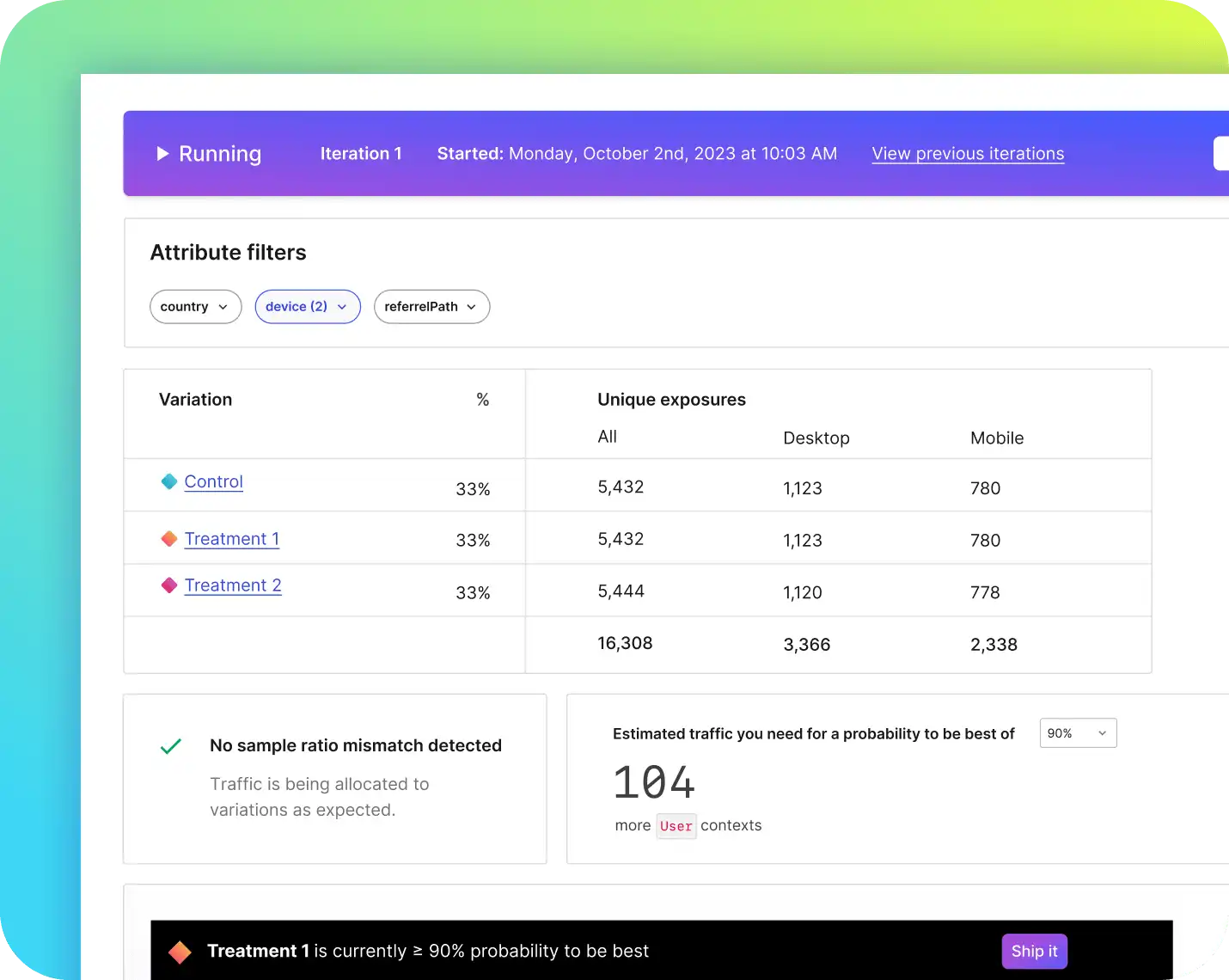
What is LaunchDarkly?
LaunchDarkly is an enterprise feature flag and A/B testing platform. It helps developers de-risk releases, target experiences, and optimize their products. It provides automation and governance features to ensure teams are following engineering best practices.
Key features
Feature flags: Control and target the release of features using multi-variate flags with real-time updates and local evaluation.
Experimentations: Run A/B/n tests against metric groups and segment. Easily roll out winning variants.
Automation: Advanced automations enable teams to not only schedule flag states, but do progressive rollouts and trigger workflows.
Governance: Audit flag changes. Get visibility into flag state across platforms. Use roles-based access controls to decide who can access and change flag states.
How does LaunchDarkly compare to Split?
LaunchDarkly and Split are nearly identical in their feature sets. LaunchDarkly does have a greater depth in its enterprise feature, but this comes with the downside of not being self-serve.
Why do companies use LaunchDarkly?
According to G2 reviews, users appreciate these aspects of LaunchDarkly:
SDKs: Reviewers appreciate how easy it is to integrate LaunchDarkly into their apps thanks to the range of SDKs they provide like JavaScript, Python, Android, and iOS.
Automations: LaunchDarkly provides automations like scheduled rollouts, rollout templates, DevOps pipeline integrations, and stale flag cleanup.
Speed and availability: High uptime and speed are critical for developers. Reviewers highlight local caching and edge computing integrations as critical ways LaunchDarkly supports these.
Bottom line
Although LaunchDarkly has a near-identical feature set to Split, it isn't self-serve. For teams needing strong governance and automation tools, LaunchDarkly makes a good choice. For smaller teams, there are likely better options.
Install PostHog with one command
Paste this into your terminal and make AI do all the work.
3. VWO
- Founded: 2009
- Similar to: PostHog, AB Tasty
- Typical users: Product managers, engineers, UX designers
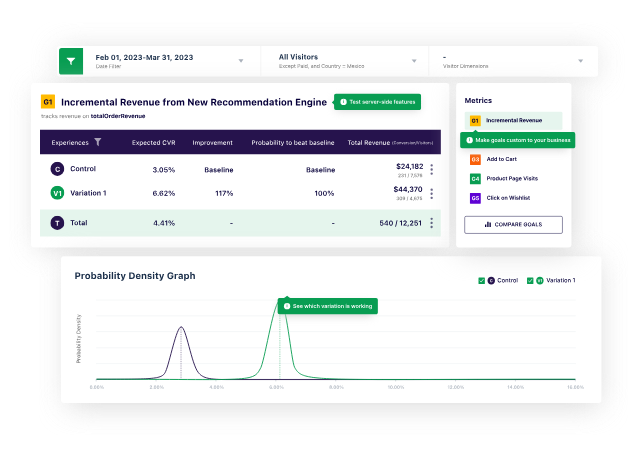
What is VWO?
VWO is a digital experience optimization platform that aims to maximize conversion with tools like A/B testing, personalization, funnels, heatmaps, session replay, and customer analytics. It also has feature flags.
The VWO platform includes testing, insights, data, personalize, plan, and web rollouts – and each comes with its own feature sets and pricing.
Key features
A/B testing: Improve and optimize experiences with experiments. Run tests to improve web and mobile as well as server-side A/B testing.
Data platform: Collect and analyze customer data across your stack using SDKs, third-party integrations, and direct uploads.
Insights: Understand your users with session recordings, heatmaps, analytics, and surveys.
Personalization: Create and tailor user journeys and campaigns for specific audiences, locations, and times.
Planning: Ideate, prioritize, and plan optimization campaigns in one location and connect them directly to data.
How does VWO compare to Split?
Similar to PostHog, VWO is a multi-product platform that includes most of the features of Split.
VWO has analytics, though it's behavioral analytics, like session replays and heatmaps, rather than product analytics.
Why do companies use VWO?
Based on G2 reviews, the biggest reasons to choose VWO are:
Support: VWO's support staff are knowledgeable, helpful, and responsive. This helps people get the most out of the platform from onboarding onwards.
Multi-use: Reviewers like that they can combine A/B tests with surveys, funnels, session replays, and analysis tools to optimize the complete user experience.
Data-focused: VWO enables both technical and non-technical to make better data-driven decisions by being the complete source of experience data.
Bottom line
Larger conversion-focused companies will likely find VWO a solid alternative to Split. VWO has the key features of Split plus behavioral analytics, personalization, and more.
4. GrowthBook
- Founded: 2020
- Similar to: Split, Harness
- Typical users: Engineers and data scientists
- Typical customers: Security and compliance focused companies
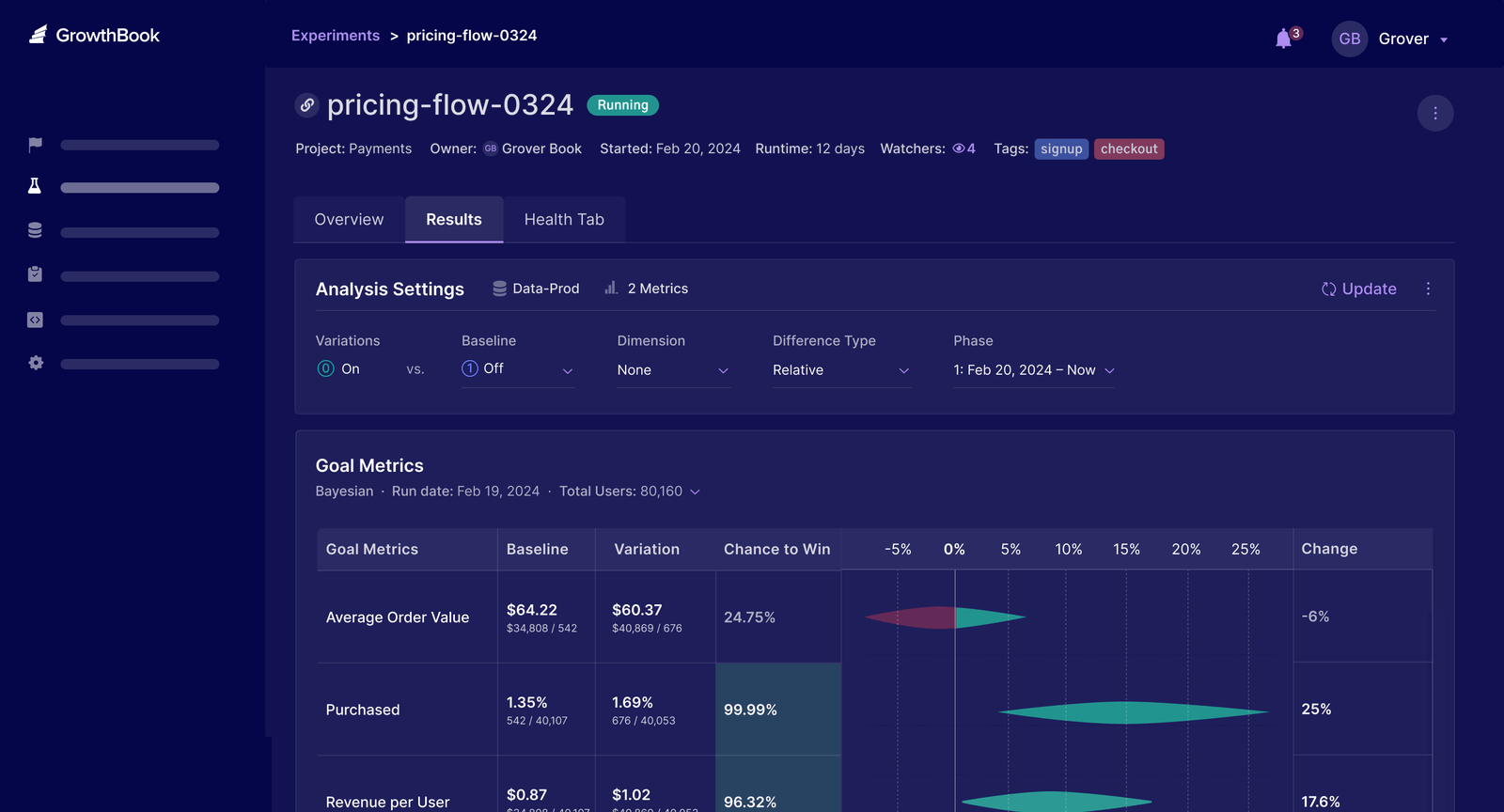
What is GrowthBook?
GrowthBook is a warehouse-native feature flag and experimentation platform. Its biggest selling point is integrating with the product and data tools you already use. Being open source and warehouse-native makes it a popular choice with companies in strict regulatory environments.
GrowthBook is open source with 5.5k stars on GitHub. It is self-hostable, but you can also use its hosted cloud version.
Key features
Warehouse-native: Designed to integrate seamlessly with your existing data tools like Snowflake or Postgres.
Feature flags: Robust feature-flagging capabilities with custom targeting and scheduling.
A/B testing: Experimentation suite built on feature flags with a visual editor to optimize UI changes.
Analysis: Use either Bayesian or Frequentist engines. Connect your existing data and do retroactive analysis.
Integrations: Connects with data warehouses and analytics tools, but has limited integrations beyond that.
How does GrowthBook compare to Split?
GrowthBook's biggest plus-points are that it's open source and warehouse-native. Though it does miss some of Split's more advanced features.
Why do companies use GrowthBook?
According to G2, reviewers choose GrowthBook for the following.
Warehouse native: GrowthBook's integrations with the warehouses people are already using is a standout feature. It enables them to extract and make use of the data they already have.
Visual editor: The visual A/B test editor and experiment preview enable non-technical users to make full use of GrowthBook.
Self-hostable: Reviewers like that they have full control over GrowthBook by running it on their own infrastructure. This means no limits to data.
Bottom line
Being open source, free, and self-hostable, GrowthBook makes for a good alternative to Split, especially for companies in tricky regulatory situations.
5. AB Tasty
- Founded: 2013
- Similar to: Kameleoon, VWO
- Typical users: Marketing and product teams
- Typical customers: Large retail and entertainment companies
What is AB Tasty?
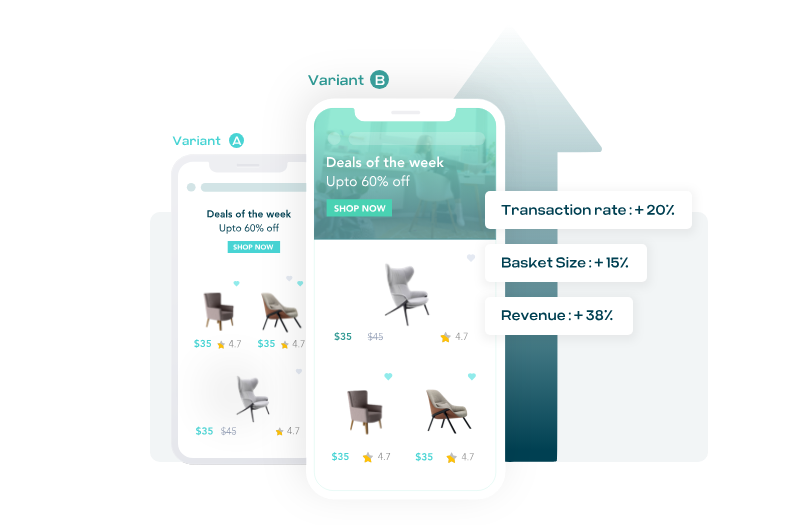
AB Tasty is a set of tools for optimizing brand and product experiences. This includes experimentation, personalization, and recommendations.
It helps teams build better end-to-end digital user experiences that drive ROI, engagement, and loyalty. The company focuses on retail, entertainment, and ecommerce companies.
They've recently merged with VWO and are in the process of integrating the two platforms, so some features may be in flux.
Key features
Web experimentation: Run A/B and multivariate tests easily with low/no-code tools like a visual editor and pre-built widgets.
Feature experimentation: Test new features on specific users or segments in your server-side or mobile apps.
Personalization: Create personalized experiences with audience builder and segmentation tools. Make programmatic changes to your site.
Rollouts: Use feature flags to progressively deliver, manage, and rollback new features.
Recommendations: Show the right products at the right time in customer journeys. Provide unique suggestions to increase conversion.
How does AB Tasty compare to Split?
AB Tasty has the closest feature set of all the listed alternatives to Split, with the bonus of personalization and recommendation tools. This does mean that both miss out on more advanced analytics tools, however.
Why do companies use AB Tasty?
According to G2 reviews, users choose AB Tasty for the following reasons:
Ease-of-use: Non-technical users can create and manage simple A/B tests using the visual editor. People also like how simple and intuitive the entire platform is.
Support: AB Tasty's customer support receives high praise. The company also has an option to help you with recommendations and implementation, for a cost, if you need it.
Widgets: Reviewers enjoy AB Tasty's collection of pre-built widgets such as alerts, banners, and modals to help personalize experiences.
Bottom line
For companies needing personalization and recommendations on top of the feature set of Split, you can do worse than AB Tasty. If you want to try before you buy, you should look elsewhere.
6. Kameleoon
- Founded: 2012
- Similar to: LaunchDarkly, AB Tasty
- Typical users: Product managers and developers
- Typical customers: Mid-sized ecommerce, retail, and entertainment companies

What is Kameleoon?
Kameleoon is a developer-focused complete optimization platform with A/B testing, feature management, and personalization. On top of these, it includes an AI copilot that helps generate options, do predictive targeting, assist in decisions, and more.
According to BuiltWith, as of April 2024, 816 of the top one million websites deploy Kameleoon. This is the closest of the alternatives to Split's 177.
Key features
Web experimentation: Use their smart graphic editor and widget library to run flicker-free A/B tests on your website.
Feature experimentation: Do targeted rollouts of features and analyze their impact.
AI copilot: Have AI help with targeting, decision-making, and experiment creation.
Stats accuracy: Provides advanced stats like sample mismatch ratio, cross-campaign analysis, CUPED, and multiple test correlation.
How does Kameleoon compare to Split?
Although it isn't self-serve and doesn't have local evaluation for feature flags, Kameleoon matches up closely with Split when it comes to feature sets. It also includes a personalization feature that Split doesn't have.
Why do companies use Kameleoon?
According to G2 reviews, users are big fans of the following aspects of Kameleoon:
Statistical tools: Reviewers are more confident about the results of their experiments thanks to Kameleoon's different statistical engines and AI copilot.
Editors: The combination of the graphics and widget editors makes it easy to set up A/B tests and personalizations.
Integrations: Reviews like how Kameleoon integrates with all the tools they already use like Google Analytics, Adobe Analytics, and Mixpanel.
Bottom line
For companies looking for a developer-focused optimization platform, Kameleoon is a good alternative. Though it not being self-serve is a major downside.
Which Split/Harness alternative should you choose?
- Need a full platform covering feature flags, A/B testing, product analytics, session replay, error tracking, and more – all with transparent pricing and a free tier? PostHog is the most complete alternative.
- Engineering team focused on safe, governed feature releases at scale, with strong audit logs, RBAC, and automation? LaunchDarkly is the closest like-for-like replacement for Split.
- Focused on conversion optimization and want behavioral analytics like heatmaps, session replay, and personalization alongside experimentation? VWO is built for that.
- Need an open-source, warehouse-native option you can self-host and keep all data in-house? GrowthBook is the best fit.
- Want experimentation and personalization with pre-built widgets and strong no-code tooling for marketing teams? AB Tasty is worth considering.
- Looking for a developer-focused platform with advanced statistical tooling and AI-assisted targeting? Kameleoon is a strong option.
Is PostHog right for you?
Here's the (short) sales pitch.
We're biased, obviously, but we think PostHog is the perfect Split replacement if:
- You value transparency. We're open source and open core.
- You want more than just A/B testing and feature flags. We have a full suite of product analytics, session replays, surveys, and more.
- You want to try before you buy. We're self-serve with a generous free tier.
It's completely free to get started – no credit card required. Our AI setup wizard handles configuration in minutes, or you can check out our docs to do it yourself.
Install PostHog with one command
Paste this into your terminal and make AI do all the work.
Frequently asked questions
PostHog says it makes your product "self-driving" – what does that mean?
It means PostHog digs through your product data, finds what's worth fixing, and has agents do the work.
It starts with context. A full suite of developer tools – AI Observability, Product Analytics, Session Replay, Feature Flags, Experiments, Error Tracking, Logs, and more – captures everything happening in your product, and a Context Warehouse unifies it into one source agents can read across.
From there, Scouts read across all of it and sort what's worth knowing from what's just noise. What clears the bar becomes a report in your inbox: an agent picks it up, roots out the cause, and opens a PR. You review and merge.
You can steer it from Slack, the web app, the desktop app, or your own editor via the MCP or CLI.
What happened to Split.io?
Split.io was acquired by Harness in June 2024 and rebranded as Harness Feature Management & Experimentation (FME). The core feature flag and experimentation functionality carries over, but the product is now part of a broader DevOps platform rather than a standalone tool.
Existing Split customers were migrated to the Harness platform. If you're evaluating alternatives during this transition, the tools on this list are comparable options.
What is the best free Split.io alternative?
PostHog is the strongest free alternative. It offers 1 million feature flag requests (combined with experimentation), 1 million analytics events, and 5,000 session replays – all free, no credit card required. GrowthBook is another strong free option, especially for teams that want a self-hostable, open-source solution.
What is the best open-source Split.io alternative?
GrowthBook and PostHog are both open source. GrowthBook is warehouse-native and particularly well-suited to teams in strict regulatory environments. PostHog is a broader platform that also includes product analytics, session replay, and surveys alongside feature flags and experiments.
What is the best Split.io alternative for enterprise teams?
LaunchDarkly is the closest enterprise-grade alternative to Split, with a near-identical feature set and strong governance, automation, and audit tooling. Kameleoon is also worth considering for teams that prioritize statistical rigor and developer tooling.
What are the best feature flag tools?
It depends on your needs. For a full breakdown, see our guides to the best feature flag software for developers and the best open-source feature flag tools.
If you're new to the concept, read our guide to what feature flags are first.

Subscribe to our newsletter
build mode
Read by 75,000+ founders and builders
We'll share your email with Substack
PostHog is the leading platform for building self-driving products. With a full suite of developer tools – AI observability, product analytics, session replay, feature flags, experiments, error tracking, logs, and more – PostHog captures all the context agents need to diagnose problems, uncover opportunities, and ship fixes. A data warehouse and CDP tie it all together, unifying that context into one source agents can read across. You can steer it all from Slack, the web app, the desktop (PostHog Desktop), or your own editor via the MCP.